

Highlights of the Golden Period
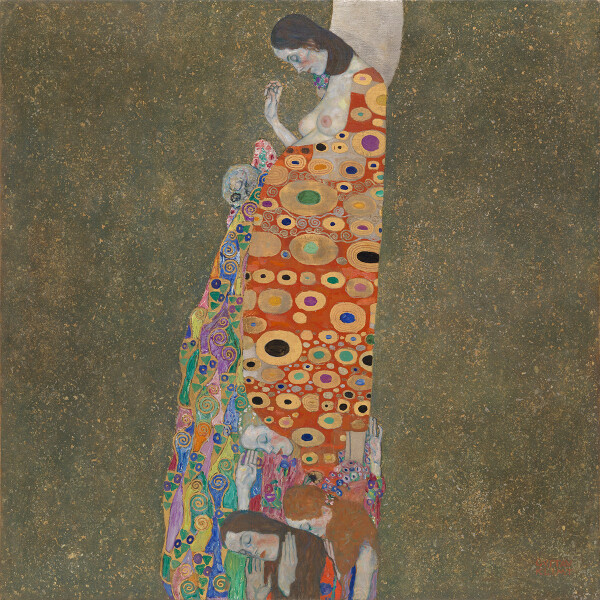
Gustav Klimt: Hope II (Vision), 1907/08, The Museum of Modern Art (MoMA), Jo Carole and Ronald S. Lauder and Helen Acheson Funds, and Serge Sabarsky
© Scala Florence
Some of Gustav Klimt’s most prestigious masterpieces were created in the years between 1907 and 1909. In his paintings The Kiss (Lovers) and Portrait of Adele Bloch-Bauer II, he carried the effect of gold to its height. In his works Hope II, Danaë, and Judith II, he dealt with the image of women around 1900.
Hope II (Vision)
In 1909, the painting Hope II (Vision) (1907/08, reworked before 1914, The Museum of Modern Art, New York) was first presented under the title of Vision at the “Internationale Kunstschau Wien,” where it was juxtaposed with the first version of the subject, Hope I (1903/04, National Gallery of Canada, Ottawa).
As he had been in the first version, in this work Klimt was also concerned with the existential questions of becoming and passing away, of life and death. As early as 1909, Berta Zuckerkandl noted that the woman well advanced in pregnancy in Klimt’s work stands for “eternally sprouting life that victoriously overcomes illness and death.” Yet as opposed to the first version of the theme, Klimt did without the threatening figures above and behind the pregnant woman, limiting the menacing aspect of the scene to a skull, which, however, lies directly on the pregnant woman’s belly. She has bowed her head as if to pray for her child. Three other women form what resembles a pedestal, on which the protagonist seems to be standing. With their arms raised, they, too, appear to be praying. Colorful ornaments, spirals, and a shimmering golden background reminiscent of medieval icons identify the square picture as a typical composition of the Golden Period.
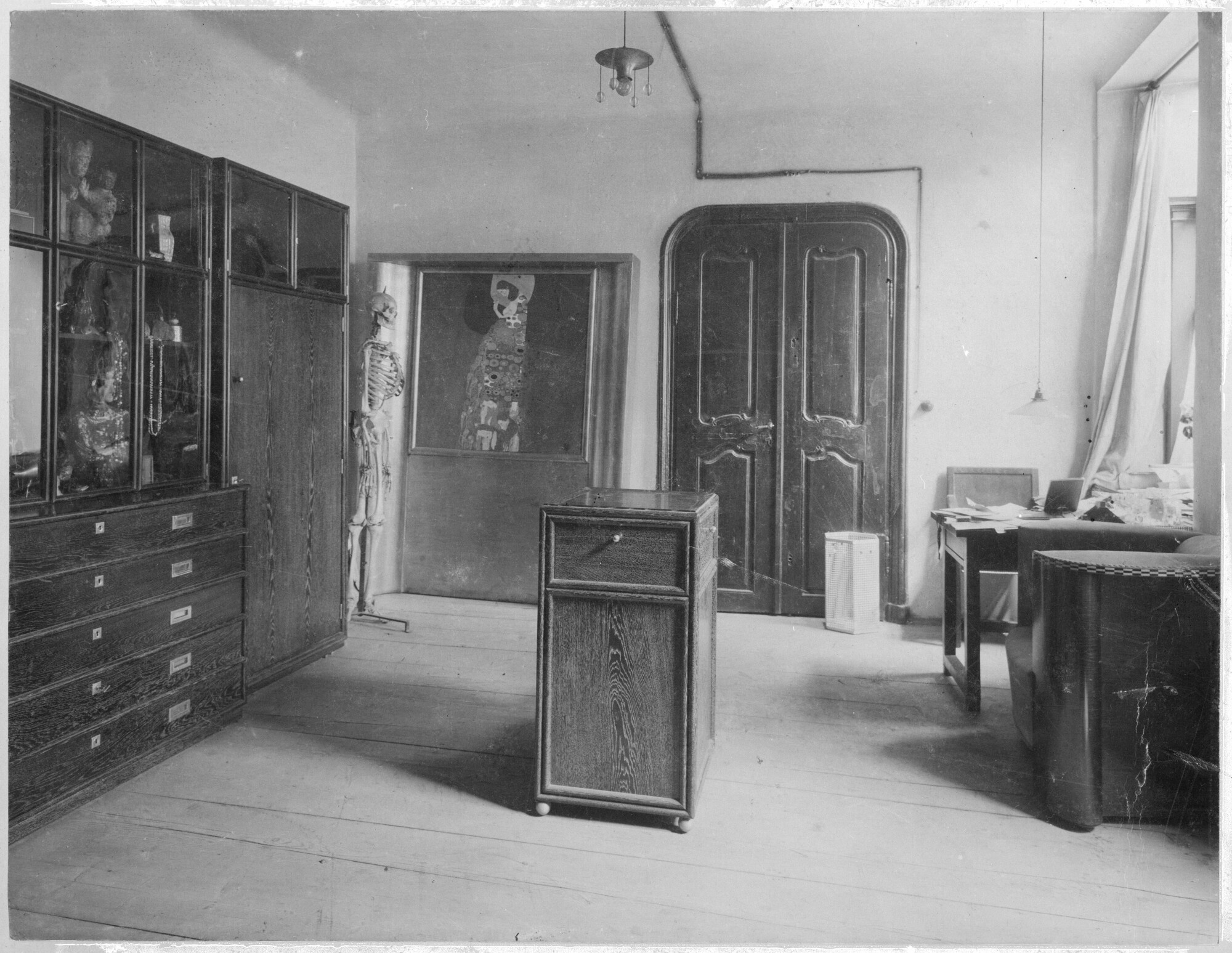
Moriz Nähr: Anteroom of Gustav Klimt's studio in Josefstädter Straße, May 1911, Österreichische Nationalbibliothek, Bildarchiv und Grafiksammlung
© Picture Archives and Graphics Department, Austrian National Library
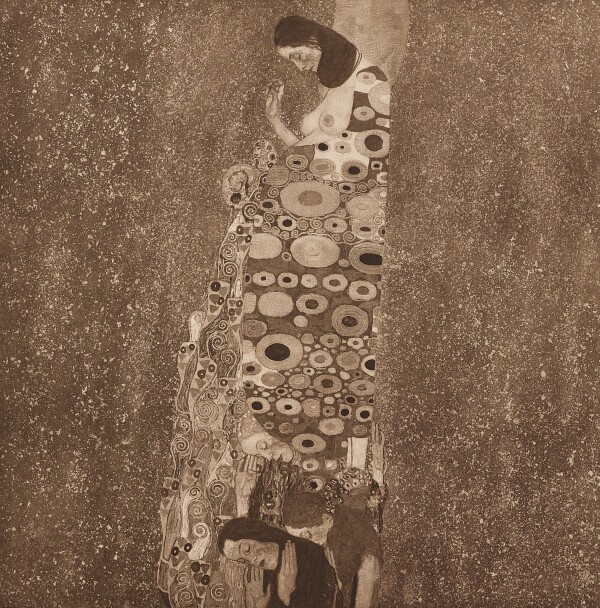
Gustav Klimt: Hope II (Vision), 1907/08, The Museum of Modern Art (MoMA), Jo Carole and Ronald S. Lauder and Helen Acheson Funds, and Serge Sabarsky
© Klimt Foundation, Vienna
Although the work had already been exhibited in 1909, Klimt revised it several times afterwards. It was not uncommon for the artist to make further changes to supposedly finished paintings if they were not yet sold. A picture of Klimt’s studio at No. 21 Josefstädter Straße taken by the photographer Moriz Nähr in 1911 shows the original version of the painting leaning against the wall next to a skeleton model. Comparing the final version of the work with the photograph of the artist’s studio from 1911 shows that Klimt made various changes between 1911 and 1914. The most conspicuous modifications concern the pregnant woman’s circular nimbus, which Klimt eventually reduced to a semicircle, and the handling of the background.
The painting found an admirer in Eugenia Primavesi. She had seen it in the artist’s studio in 1914 and had been thrilled by it. That same year, she received the work from her husband Otto as a Christmas present. On New Year’s Day, Eugenia wrote:
“On Christmas Eve, a picture by Klimt came as a surprise, the one I liked so much when visiting his studio some time ago on a Saturday – Vision it is called, and I am very pleased with it.”
When the work was purchased and installed at the Villa Primavesi in Olomouc, the lengthy painting process thus came to a sudden end.
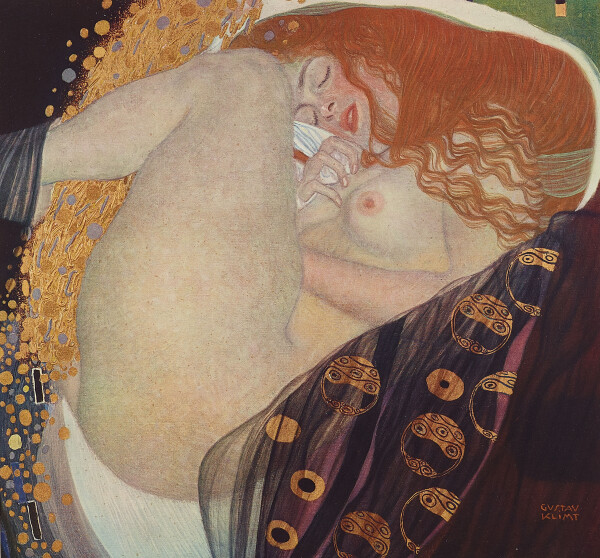
Gustav Klimt: Danaё, 1907/08, private collection
© Klimt Foundation, Vienna
Danaë
Like in Judith I (1901, Belvedere, Vienna), in the painting Danaë (1907/08, private collection) Klimt made use of a traditional theme from art history, which he revisited for the sake of depicting sensual eroticism. Klimt thus reinterpreted the mythological tale of Zeus ravishing the beautiful Danaë during her sleep in the form of a shower of gold. Due to the protagonist’s closed eyes and softly parted lips, with her hand disappearing between her thighs, the scene of a rape becomes an erotic act of love. As if in ecstasy, Danaë pulls her blanket to her breast. Contemporaries such as Fritz Waerndorfer already noticed the protagonist’s erotic pleasure when Klimt presented the work for the first time at the “Kunstschau Wien” in 1908:
“A Danaë penetrated by a golden stream as if it were a giant penis [note: the German original uses the obscene dialect expression “Mordsschwaf”], which gives her ultimate pleasure.”
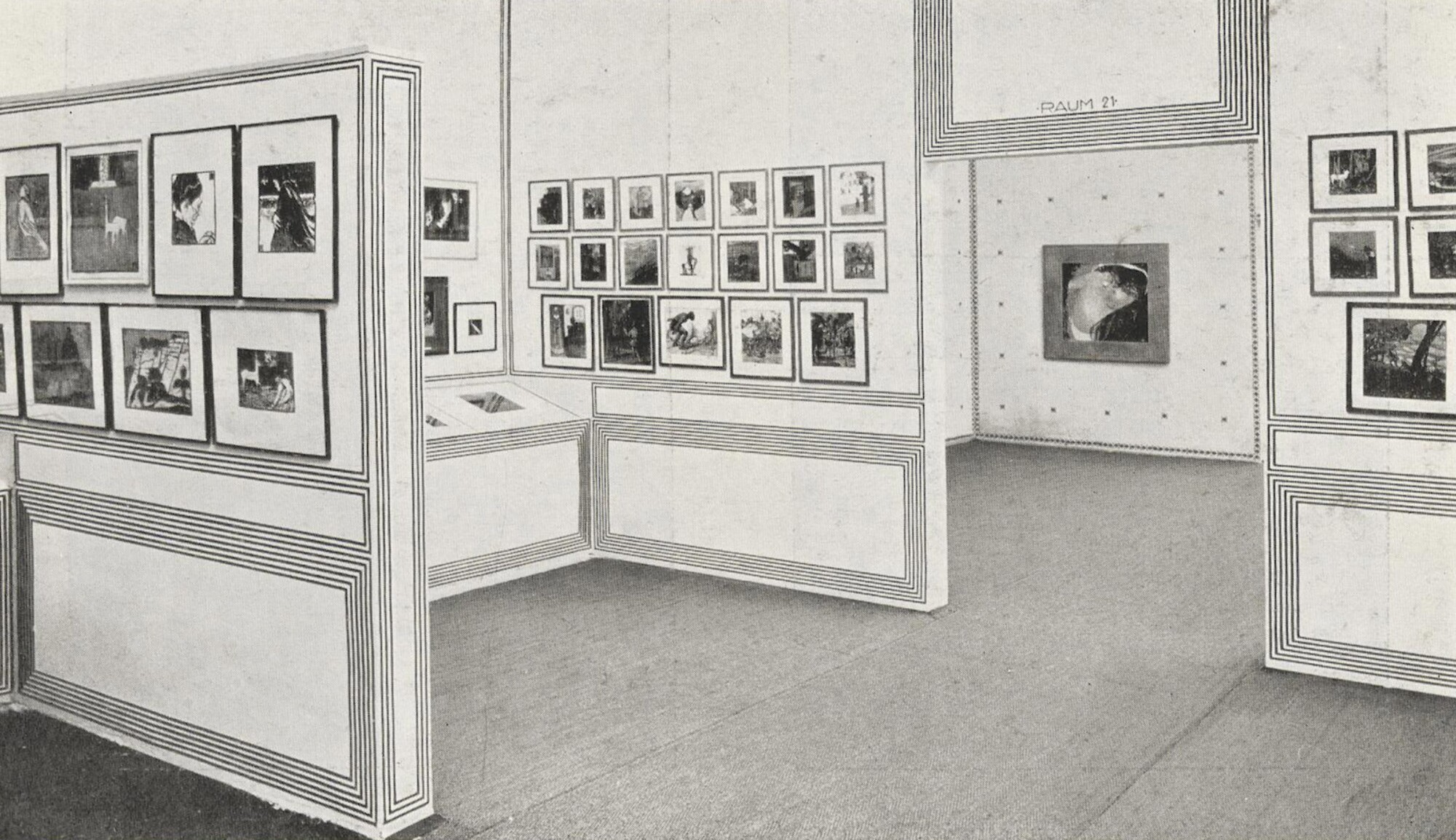
Insight into the Vienna Art Show 1908, June 1908 - November 1908
© Heidelberg University Library
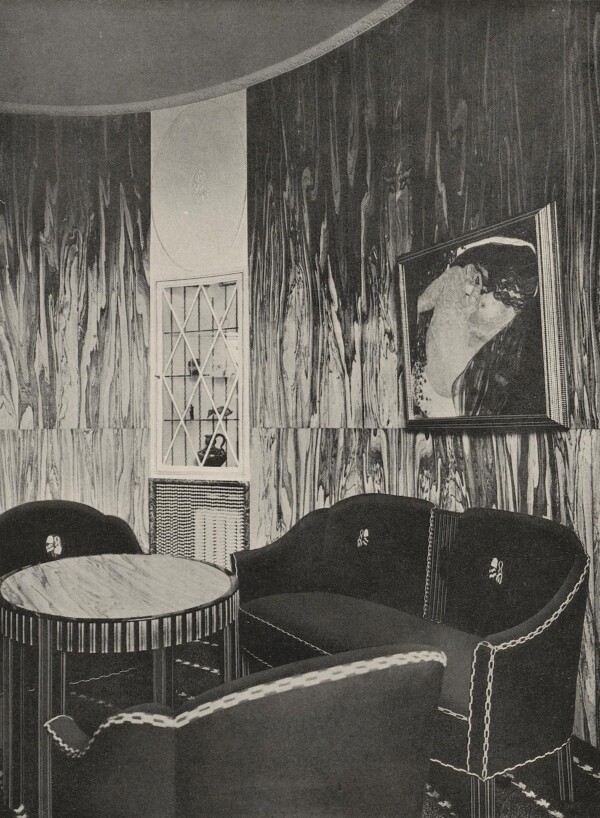
Bruno Reiffenstein (?): Insight into the Villa Ast, circa 1913, MAK - Museum für angewandte Kunst, Bibliothek und Kunstblättersammlung
© Heidelberg University Library
In terms of form and content, this picture is reminiscent of Klimt’s numerous drawings of masturbating women, which became increasingly common, especially in his later years. Moreover, the crouching posture and the closed eyes are reminiscent of an erotic dream. The painter seems to have been primarily concerned with the display of the sensation of sexual pleasure, independent of the presence of a man. The mythology surrounding Zeus – in which the god never appears in human form – probably played into Klimt’s hands here, as he took up this theme again in his erotic Leda (1917, destroyed by fire at Immendorf Castle in 1945).
Artists had gotten away with creating erotic depictions for decades under the cloak of mythological iconography, thereby circumventing the period’s moral censorship. After all, watching a sleeping woman with her left hand disappearing between her thighs does not lack a voyeuristic touch. Édouard Manet had already been heavily criticized for a similar subject in his work Olympia (1863, Musée d’Orsay, Paris).
Once again, gold plays an important role here. The precious metal preferred by Klimt during his Golden Period is not only found in the brocade elements of the violet fabric – which are sometimes also interpreted as blastocysts, i.e. embryonic cells supposed to symbolize Danaë’s impregnation; as golden rain it even becomes the objectified divine, thus detaching itself from its function as a decorative element.
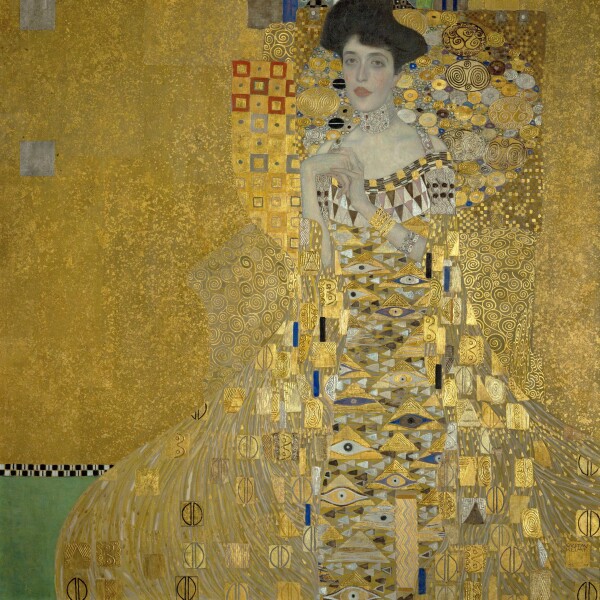
Gustav Klimt: Portrait of Adele Bloch-Bauer I, 1907, Neue Galerie New York, Acquired through the generosity of Ronald S. Lauder, the Heirs of the Estates of Ferdinand and Adele Bloch-Bauer, and the Estée Lauder Fund
© APA-PictureDesk
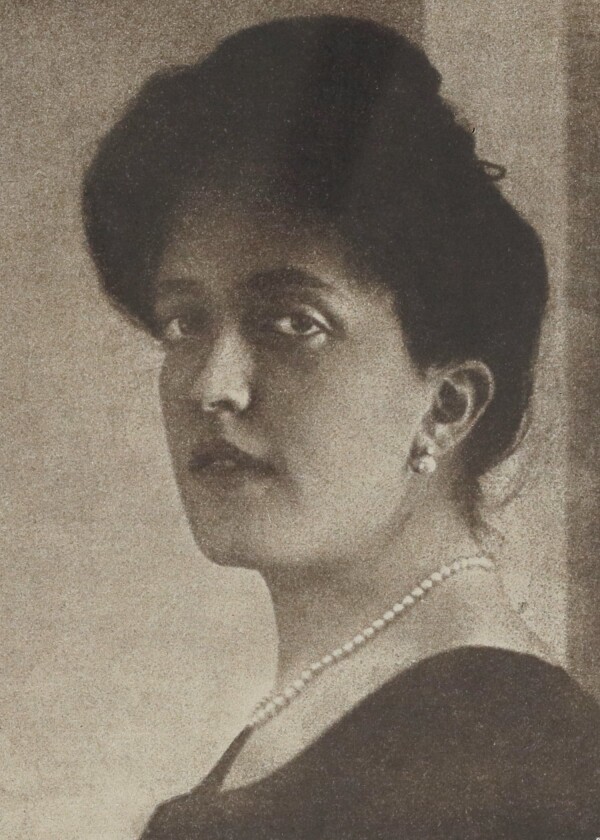
Adele Bloch-Bauer, photographed by Friedrich Viktor Spitzer, 1906, in: Photographische Rundschau und photographisches Centralblatt. Zeitschrift für Freunde der Photographie, 22. Jg., Heft 3 (1908).
© Klimt Foundation, Vienna
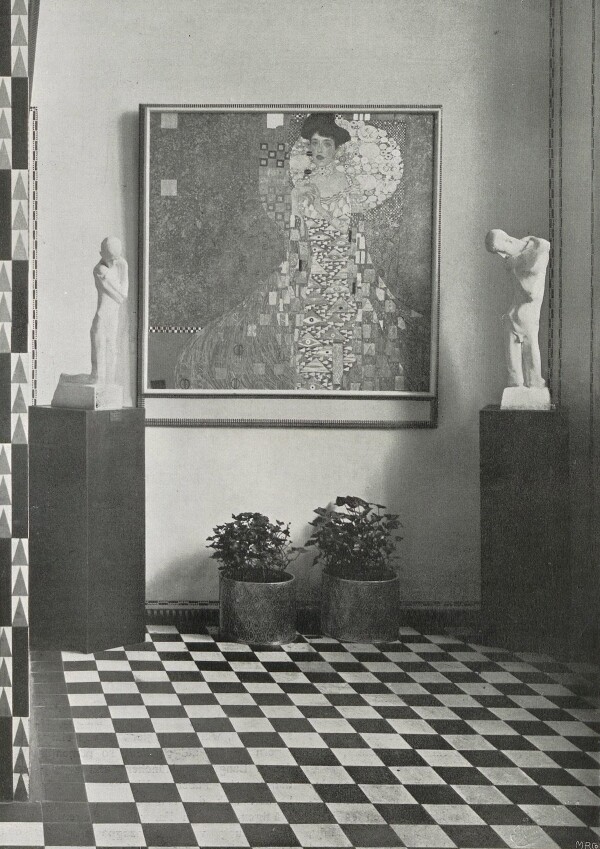
Insight into the anniversary exhibition in Mannheim, May 1907 - October 1907
© Heidelberg University Library
Adele Bloch-Bauer I
“[B]ut with Klimt, there are flashes, thunders, and hailstorms of glistening gold, an entire Nibelung treasure descending, cracking and rattling, a golden downpour!”
Portrait of Adele Bloch-Bauer I (1907, Neue Galerie New York) is not only one of the painter of women’s most famous portraits, but certainly also a masterpiece of the Golden Period. Using gold leaf and ornamentation, the artist transformed his sitter into a “sparkling jewel,” a disembodied apparition. Klimt’s sources of inspiration ranged from Byzantine mosaics to late 19th-century painting and traditional Japanese art. Klimt was thus very much in line with the style of his time, for Hans Makart, Fernand Khnopff, and the Pre-Raphaelites also loved the precious metal.
Klimt’s first portrait of the then 26-year-old Adele Bloch-Bauer is one of his most prominent paintings and a masterpiece of the Golden Period. A letter from Adele Bloch-Bauer proves that Klimt was first commissioned with the portrait as early as the summer of 1903:
“My husband subsequently decided to have my portrait painted by Klimt, who, however, can only set to work this coming winter.”
But for reasons unclear, the Bloch family had to wait considerably longer for the portrait, which had originally been intended as a gift to Adele’s parents for their wedding anniversary. It was not until 1907 that Klimt completed Portrait of Adele Bloch-Bauer I, with a frame based on a design by Josef Hoffman.
Like with The Three Ages of Woman (1905, Galleria Nazionale d’Arte Moderna e Contemporanea, Rome) and Portrait of Fritza Riedler (1906, Belvedere, Vienna), contemporaries referred to the work as “mosaic picture.” This term refers to the arts-and-crafts character of the three paintings, as well as Klimt’s fusion of painting and decorative arts elements, an approach he would subsequently carry to an as yet unparalleled peak in the Stoclet Frieze (1905–1911, private collection). The mosaic character of the works was fed by impressions Klimt had gathered during a trip to Italy in 1903, when he visited the cathedral of Ravenna. There it was for the first time that he saw the golden Byzantine “mosaics of a splendor unheard of,” which had a lasting impact on the entire output of his Golden Period.
The use of gold and the understanding of a painting as decorative ornament reached unknown heights in Portrait of Adele Bloch-Bauer I. With its golden spirals, the upholstered chair optically blurs into the background, as does the sitter’s dress. Gold becomes the dominant pictorial component, broken only by a few accents of color. All three-dimensional objects are noticeably abstracted, to which the sitter’s naturalistically rendered head and hands stand in stark contrast. Orthodox icons, which have always combined painted images of saints with golden metal frames, may have served as an inspiration here.
Klimt thus elevates the sitter to the status of an icon, taking her to divine spheres, while, at the same time, making a statement of splendor and wealth. In this way, he presented the wealthy bourgeoisie on the rise in a way that had previously been reserved for the nobility.
Having finished his epochal Portrait of Adele Bloch-Bauer I, Klimt would not paint another commissioned portrait for four years. Work on the Stoclet Frieze and his position as president of the “Kunstschau” probably took up too much of his time to accept any more assignments. By the time Klimt painted another portrait of Adele Bloch-Bauer in 1912, he had already left the Golden Period behind and turned to bright colors and exotic, Asianizing motifs.
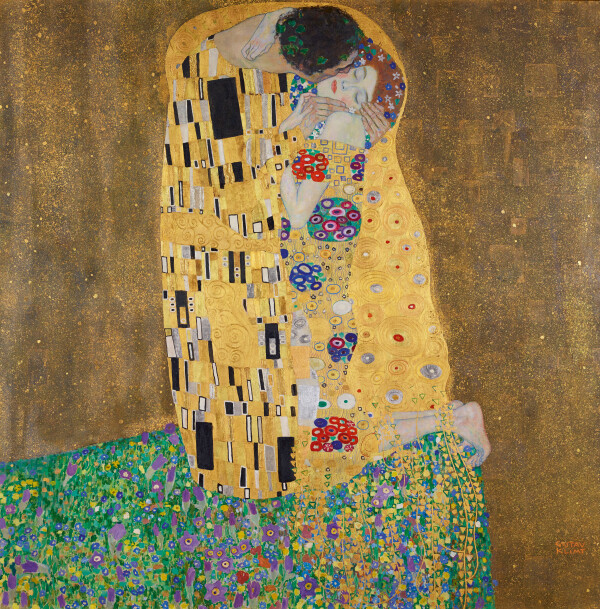
Gustav Klimt: The Kiss (Lovers), 1908/09, Österreichische Galerie Belvedere
© Belvedere, Vienna
The Kiss (Lovers)
The painting The Kiss (Lovers) (1908/09, Belvedere, Vienna) can undoubtedly be considered Klimt’s climax and endpoint of the Golden Period. Since the use of gold in Klimt’s paintings, as has already been pointed out, was based on Byzantine mosaics and the tradition of icon painting, The Kiss is also frequently referred to as “monumental icon.”
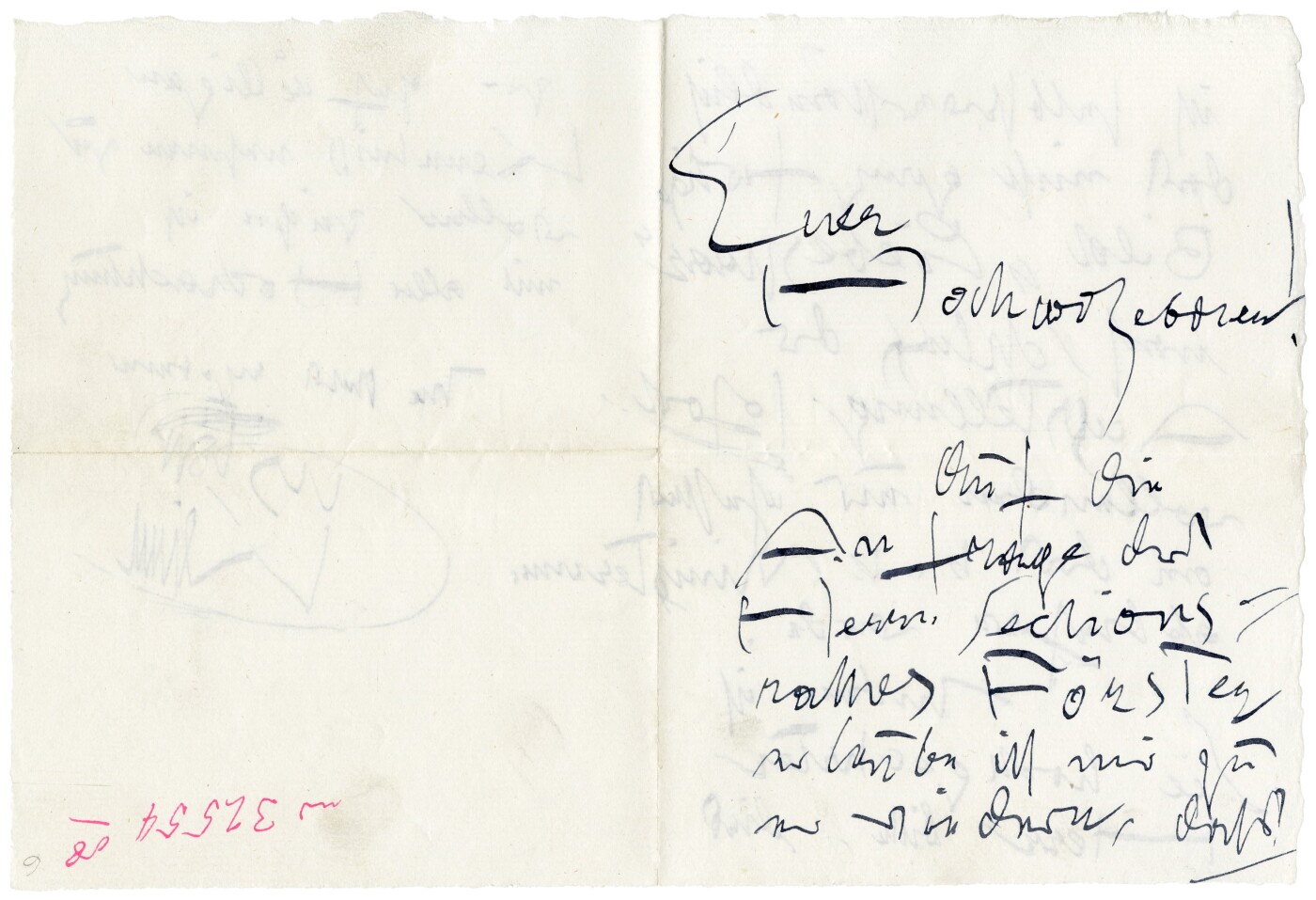
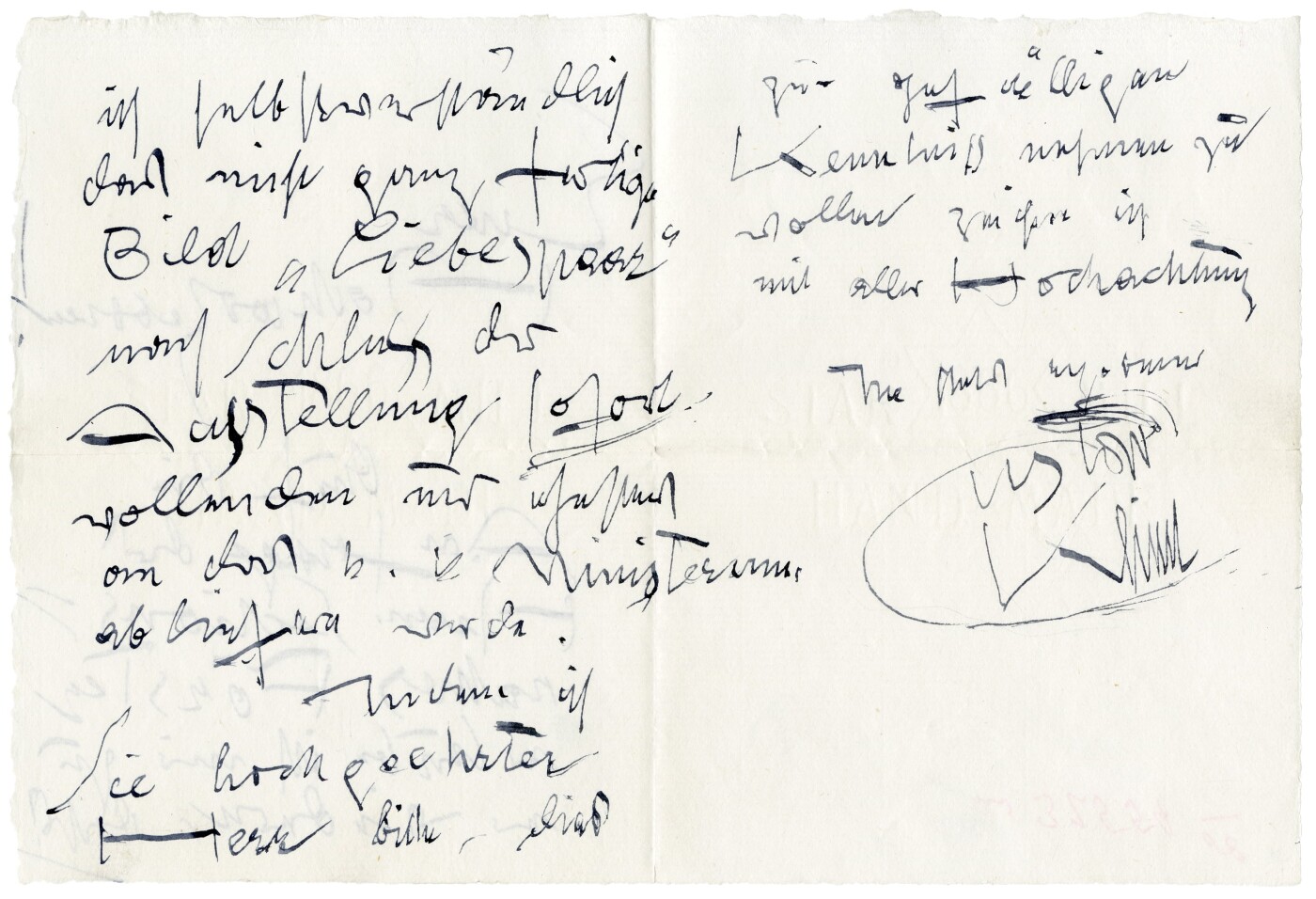
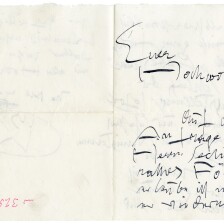
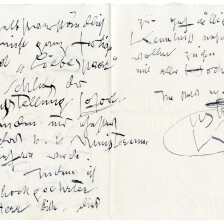
The painting was exhibited for the first time at the “Kunstschau Wien” in 1908 under the title The Lovers. The work, which was still unfinished at the time, was purchased for the Modern Gallery by the Imperial-Royal Ministry of Culture and Education. After its completion in 1909, Klimt handed it over to the ministry against payment of 25,000 crowns (approx. 155,700 euros).
“This kiss to the whole world” is a line from the final movement of Ludwig van Beethoven’s Symphony No. 9 and was an inspiration for Gustav Klimt’s Beethoven Frieze (1901/02, Belvedere, Vienna). It is this very motif of the kiss of a tightly embracing man and woman that Klimt developed further in this painting. Two lovers are shown kneeling on a cliff covered with flowers against a flickering golden backdrop typical of the Golden Period. The man bends down to the kneeling woman to kiss her on the cheek.
Letter and Envelope from Gustav Klimt to the Imperial-Royal Ministry of Culture and Education, Vienna, 16 July 1908
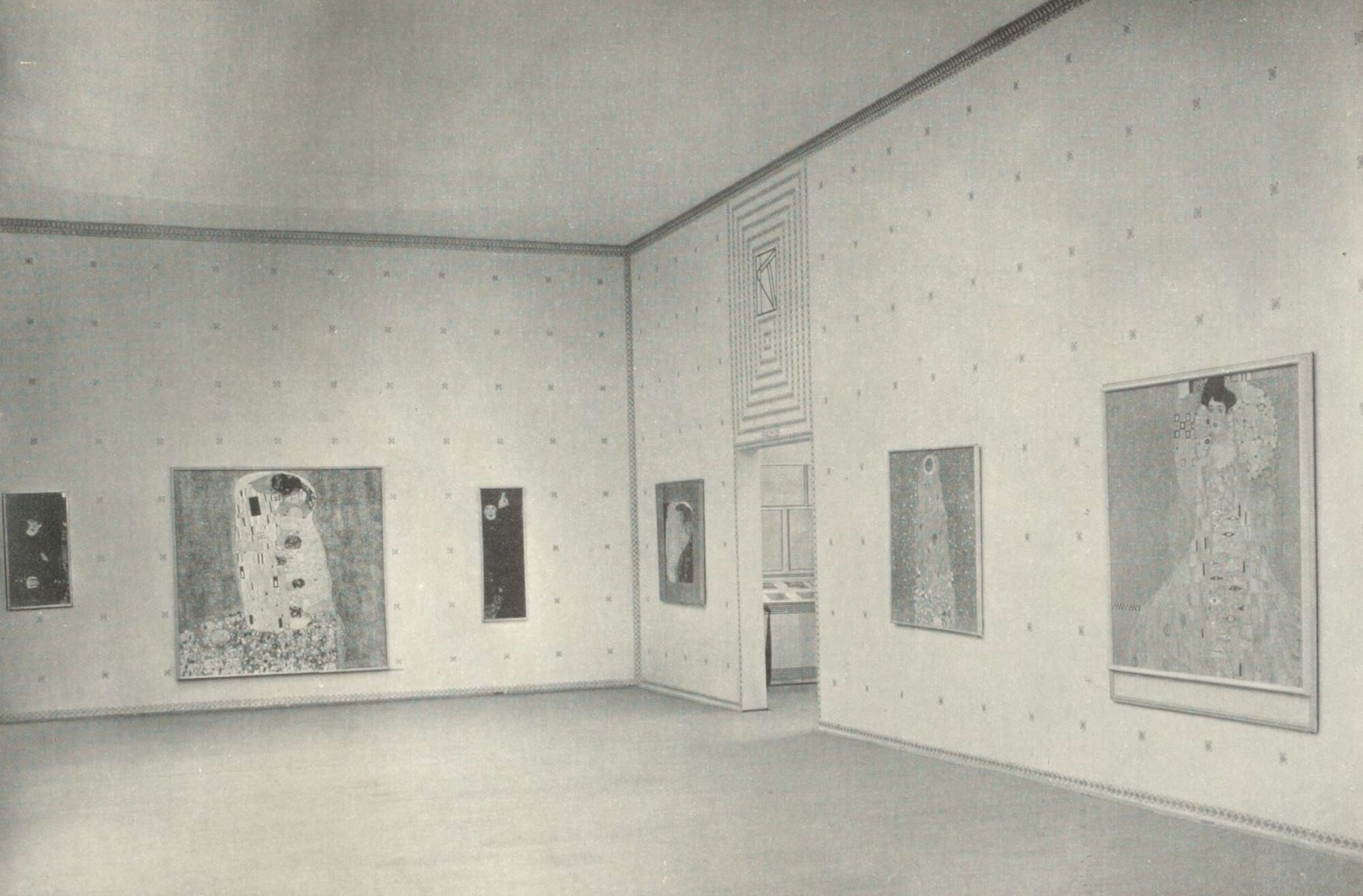
Insight into the Vienna Art Show 1908, June 1908 - November 1908
© BSB
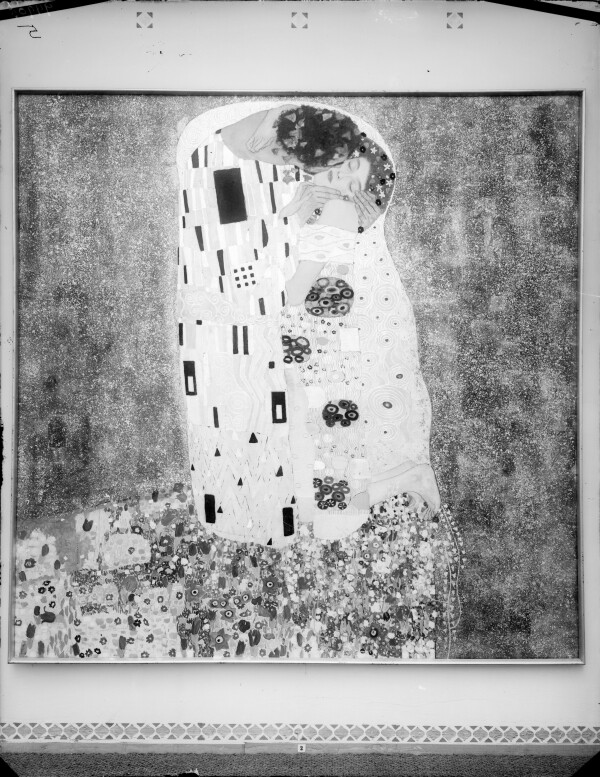
Moriz Nähr: The kiss (lovers), June 1908 - November 1908, Österreichische Nationalbibliothek, Bildarchiv und Grafiksammlung
© Picture Archives and Graphics Department, Austrian National Library
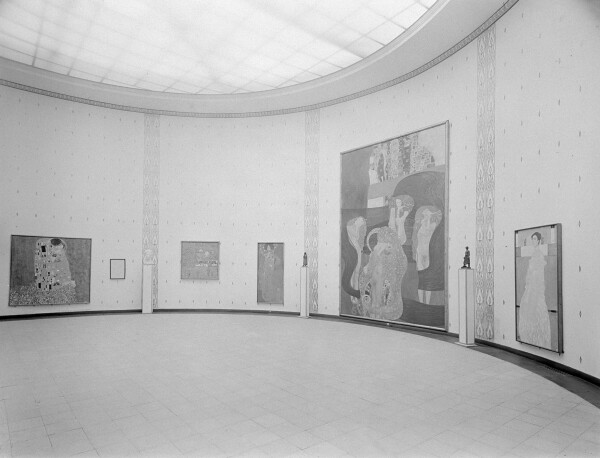
Insight into the International Art Exhibition in Rome, March 1911 - December 1911, Österreichische Galerie Belvedere, Archiv
© Belvedere, Vienna
In his composition, Klimt worked out the differences between man and woman through stark contrasts. The man’s dark skin, the hard, black rectangles of his robe, and the wild, rough ivy in his hair emphasize a stereotypical masculine hardness and rugged natural force, while the woman, with her fair skin, floral dress featuring round, feminine patterns, and delicate flowers in her hair, reflects a beautiful, gentle kind of nature. The relationship between man and woman is also clearly defined. Kneeling protectively over her, he holds her in a tight embrace, while she nestles trustingly against him with her eyes closed. For all that separates the two sexes, the gold acts as a unifying element. The two robes and the cosmic background blend in to create a single foil, with man and woman becoming one.
Klimt had already accomplished such a synthesis of the individual pictorial elements into a flat, abstract mass the previous year in Portrait of Adele Bloch-Bauer I. Edvard Munch’s woodcut The Kiss (1895, Albertina, Vienna), in which man and woman seem to share the same face, could have served as a model for the fusion of man and woman. The subject of the man holding the vulnerable woman in a protective embrace already dates back to 1902 and the first sketches for Hope I.
It is often assumed that the lovers are Gustav Klimt himself and his longtime companion Emilie Flöge. In fact, there is a brooch featuring the depiction of an embrace (30 August 1908, private property) that reproduces the Kiss motif in a modified version. The parchment support is inscribed to the right and left of the protagonists, identifying them as “Gustav” and “Emilie” respectively. A preliminary study for this brooch that has come down to us in one of Klimt’s sketchbooks (Klimt-Foundation, Vienna) is likewise inscribed “Emilie.” It therefore seems quite plausible that Klimt saw himself and Emilie Flöge in the lovers, but anonymized the protagonists in favor of a universalization of the motif. This would also be supported by the fact that Klimt painted over the man’s facial hair after the “Kunstschau Wien” of 1908 and thus removed the figure even further from the bearded artist.
Klimt repeated the motif of the embrace one more time in the panel of “Fulfillment” in the Stoclet Frieze, revisiting the composition of The Kiss in terms of both content and form.
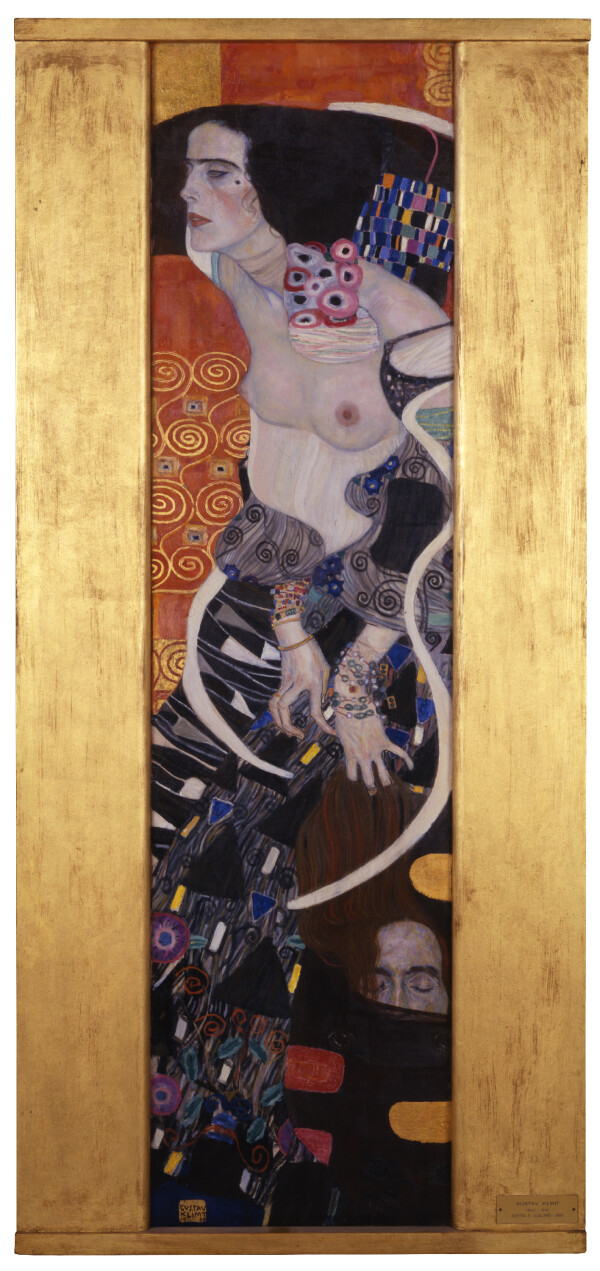
Gustav Klimt: Judith II (Salome), 1909, Ca'Pesaro - Galleria Internazionale d'Arte Moderna
© Photo Archive - Fondazione Musei Civici di Venezia
Judith II (Salome)
In 1909, Klimt once again created a threatening, man-eating femme fatale. As in Judtih I, the interpretation of the protagonist in Judith II (Salome) (1909, Galleria Internazionale d’Arte Moderna Ca’ Pesaro, Venice) oscillates between the two biblical female figures. Despite all this, when it was first presented at the “Internationale Kunstschau Wien” in 1909, the picture was exhibited under the title of Judith. The painting still bore this title in 1910 at the Venice Biennale, where it was purchased by the Venice Municipal Gallery. The painting was thus never officially titled “Salome” by the artist himself, although much would speak in favor of this association in terms of form. The dancer with the exposed décolleté, dull eyes, and fingers cramped into claws looks much more like the seductive dancer than the virtuous avenger.
Around 1900, the figure of Salome increasingly found its way back into the visual arts. Particularly Oscar Wilde’s drama Salome, published in 1896, caused a genuine hype around the scandalous dancer. Klimt was thus able to draw from a veritable repertoire of models for his Judith/Salome. Besides pictures by Aubrey Beardsley, Lovis Corinth, and Gustave Moreau, Franz Stuck, whose works had already been an impetus for Judith I, had also created a cycle of three paintings on the theme of Salome in 1906. Adaptations of Salome also circulated in the performing arts. Between 1906 and 1907, three of the most famous dancers, Maud Allan, Ruth St. Denis, and Mata Hari, appeared in Vienna as seductive femmes fatales. It is highly likely that Klimt, who regularly frequented the theater and was working on his studies for the dancer in the Stoclet Frieze, attended some of these performances.
Klimt’s interest appears to have still been the same as in Judith I, painted almost a decade earlier. She is a sexually permissive femme fatale who appeals to the viewer, but at the same time sends out a warning through the severed male head, which suggests imminent danger. Here, however, the male component is once again pushed to the margin of the picture, taking a subordinate role. The depiction combines the sexual act and killing, pleasure and suffering, and thus calls into question the gender roles around 1900.
What is new, on the other hand, is Klimt’s interest in the movement of the figure. The motif of dancing allows him to use abstract positions of the body and billowing, flamboyantly patterned garments. What is typical of the Golden Period is the contrast between the soft, naked skin and the flat bands of patterned fabric more or less concealing corporeality. Fitted into a narrow vertical format enclosed by thick golden framing lines on the sides, the woman with her dark hair and broad hairdo, artificial posture, and the multilayered lengths of fabric, is formally strongly reminiscent of Japanese woodblock prints of dancing geishas. The woodcut The Courtesan by Keisai Eisen could have served as a model. Vincent van Gogh had already used it in his Japonaiserie Oiran (1884, Van Gogh Museum, Amsterdam). Van Gogh’s oil painting mirrors the original woodcut, thus showing the figure in the same position as Judith II. Klimt may therefore also have been based on Van Gogh’s adaptation of the subject.
Literature and sources
- Catherine Dean: Klimt, New York 1996.
- Agnes Husslein-Arco, Alfred Weidinger (Hg.): Gustav Klimt 150 Jahre, Ausst.-Kat., Upper Belvedere (Vienna), 13.07.2012–27.01.2013, Vienna 2012.
- Alice Strobl (Hg.): Gustav Klimt. Die Zeichnungen, Band II, 1904–1912, Salzburg 1982.
- Tobias G. Natter, Gerbert Frodl (Hg.): Klimt und die Frauen, Ausst.-Kat., Upper Belvedere (Vienna), 20.09.2000–07.01.2001, Cologne 2000.
- Daniela Hammer-Tugendhat: Judith, in: Tobias G. Natter, Gerbert Frodl (Hg.): Klimt und die Frauen, Ausst.-Kat., Upper Belvedere (Vienna), 20.09.2000–07.01.2001, Cologne 2000, S. 220–225.
- Hans Bisanz: Zur Bildidee „Der Kuss“ – Gustav Klimt und Edvard Munch, in: Tobias G. Natter, Gerbert Frodl (Hg.): Klimt und die Frauen, Ausst.-Kat., Upper Belvedere (Vienna), 20.09.2000–07.01.2001, Cologne 2000, S. 226–234.
- Brief von Fritz Waerndorfer in Wien an Carl Otto Czeschka (06/05/1908).
- Brief von Eugenia „Mäda“ Primavesi sen. in Winkelsdorf an Anton Hanak (01.01.1915). Mappe 17.
- Franz Smola: Il bacio e Le tre età della donna. due capolavori di Gustav Klimt a confronto, in: Maria Vittoria Marini Clarelli (Hg.): Klimt. La Secessione e l’Italia, Museo di Roma, Ausst.-Kat., Museo di Roma (Rome), 27.10.2021–27.03.2022, Rome 2022, S. 63-76.
- Felix Salten: Gustav Klimt – Gelegentliche Anmerkungen. mit Buchschmuck von Berthold Löffler, Leipzig 1903.
- Sabine Brauckamnn: Fertilization Narratives in the Art of Gustav Klimt, Diego Rivera and Frieda Kahlo: Repression, Domination and Eros among Cells, in: Leonardo, Band 44 (2011).
- Berta Zuckerkandl: Ankauf von Klimt-Werken durch Staat und Land, in: Wiener Allgemeine Zeitung, 04.08.1908, S. 3.
- Armin Friedmann: Kunstschau 1908, in: Wiener Zeitung, 09.06.1908, S. 1.
- Agnes Husslein-Arco, Alfred Weidinger (Hg.): Schlafende Schönheit. Meisterwerke viktorianischer Malerei aus dem Museo de Arte de Ponce, Ausst.-Kat., Lower Belvedere (Vienna), 14.06.2010–03.10.2010, Vienna 2010.
- Ansichtskarte von Gustav Klimt in Ravenna an Emilie Flöge in Wien (12/02/1903).
- Brief von Adele Bloch-Bauer in Elbekosteletz an Julius Bauer (22.08.1903). Autogr. 577/52-1, .
- Tobias G. Natter (Hg.): Klimt and the Women of Vienna's Golden Age. 1900–1918, Ausst.-Kat., New Gallery New York (New York), 22.09.2016–16.01.2017, London - New York 2016.
- Renée Price (Hg.): Gustav Klimt. The Ronald S. Lauder and Serge Sabarsky Collections, Ausst.-Kat., New Gallery New York (New York), 18.10.2007–30.06.2008, Munich 2007.
- Alfred Weidinger: 100 Jahre Palais Stoclet. Neues zur Baugeschichte und künstlerischen Ausstattung, in: Agnes Husslein-Arco, Alfred Weidinger (Hg.): Gustav Klimt – Josef Hoffmann. Pioniere der Moderne, Ausst.-Kat., Lower Belvedere (Vienna) - Upper Belvedere (Vienna), 25.10.2011–04.03.2012, Munich 2011, S. 202-251.